
If you’re thinking about starting a career as a Yacht Stewardess, it’s natural to want a clear picture of where it could take you. You’ve probably already researched how to land your first job, and now you’re looking further ahead. What could your life look like in one year, five years or ten years?
The short answer is that most start as a Junior Stewardess, move up to Second Stewardess after around 4 years, and can go on to become a Chief Stewardess after at least 6 years of experience. On larger yachts, there are further steps into Purser and Interior Manager roles, while on smaller yachts you might run the whole interior yourself as a Sole Stewardess. How quickly you progress, and which route you take, depends on you, the yachts you work on and a bit of luck.
Thinking long term is sensible when you’re deciding whether a career is right for you.
Working on Superyachts isn’t a casual summer job or a few weeks relaxing on deck during a gap year.
Crew who understand that it is a serious, professional career and in return it offers global travel, the chance to save well and opportunities you won’t find in a standard nine-to-five.
Whether you picture yourself as part of a large team on a mega-yacht or running your own interior on a smaller yacht, it helps to understand where the path can lead.
Before we get into the details, here are a few things worth keeping in mind.
Everyone starts at zero
Every Stewardess working today had no superyacht experience before their first job.
When you’re starting out, your goal is simply to prove you’re worth hiring. Captains and Chief Stewardesses don’t expect perfection from a junior, but they do look for potential. Without sea time on your CV, what gets you through the door is your attitude, commitment, presentation and work ethic.
Hard skills can be taught on the job, but a genuine willingness to work hard and a positive attitude can’t be faked. Show up ready to learn and let your effort do the talking. It’s a mindset that will serve you well in yachting and in any career you choose (You’ll learn all the details of this on our Yacht Stewardess Course).
You won’t be able to choose your path straight away
When you’re looking for your first job, your focus should be simple. Get on a boat, gain experience and earn a reference or two for your CV.
Early on, you rarely get to choose whether your first role is on a 35-metre yacht or a 90-metre one, whether it’s private or charter, or whether you spend winter in the Caribbean or on a refit in Palma. The time of year and the jobs available usually make that decision for you, and that’s completely normal. Rather than waiting for the perfect job, be ready to go with the flow for a while.
Your path will be unique
There’s no rigid career ladder. Two Stews can start on the same day with the same qualifications and build completely different, equally successful careers based on their strengths, priorities and a little luck.
One might thrive on a busy smaller charter yacht, enjoying the variety, plus hopefully charter tips. Another might prefer the structure, rotational leave and steadier routine of an 120m+ private yacht. Most people only discover which suits them after a year or two onboard.
You also might find you only want to work on yachts for a few seasons and that’s fine, or you might find yourself 15 years later as a Chief Stewardess and couldn’t imagine doing anything else.
Yacht size and type make a big difference
The size of the yacht, and whether it’s private or charter, shape your daily routine and what experience you’ll get.
On a smaller yacht, you’ll become an all-rounder, handling laundry, service, housekeeping and the owner’s preferences, sometimes all in one shift. On a larger yacht, roles are more structured and specialised, and you might focus on housekeeping or service for months as part of a team of eight or ten Stews.
Keep all of this in mind as you read the rest of this guide. Think of it as an outline of what’s possible rather than a fixed plan, because your career will take shape around the opportunities you take and the environment where you perform best.

Stage 1: Finding work and your first season
Roles: Junior Stewardess and dayworker
Yacht size: Any
Work type: Daywork, temporary contracts and permanent positions
Pay: Typically €2,000 to €3,000+ a month, with food and accommodation provided and tips on charter yachts
Essential qualifications: STCW Basic Safety Training, ENG1 Medical
Useful qualifications: Food Safety Level 2, Superyacht Stewardess Course, Crowd and Crisis Management
Your first year is when everything is new. You’ll earn your first salary at sea, learn the standards expected on a superyacht and start building a network of crew from all over the world. It’s the season where ambition starts turning into confidence.
As with any competitive industry, getting your first job takes hard work. Before you can apply, you’ll need to complete your STCW Basic Safety Training and pass an ENG1 seafarer medical.
Unless you already know someone in the industry, a dedicated course like our Superyacht Stewardess Course is the most reliable way to go from complete newcomer to ready for work.
We take you through the whole process, from writing a yachting CV and knowing which recruitment agencies to register with, to finding crew accommodation in Antibes or Palma and dockwalking with confidence.
For more detail, read our guide on how to get a job on a yacht with no experience.
What you’ll do day to day
In your first month at sea, your most important job is to learn. Watch how the senior Stews work, listen carefully to instructions and ask questions at the right moments.
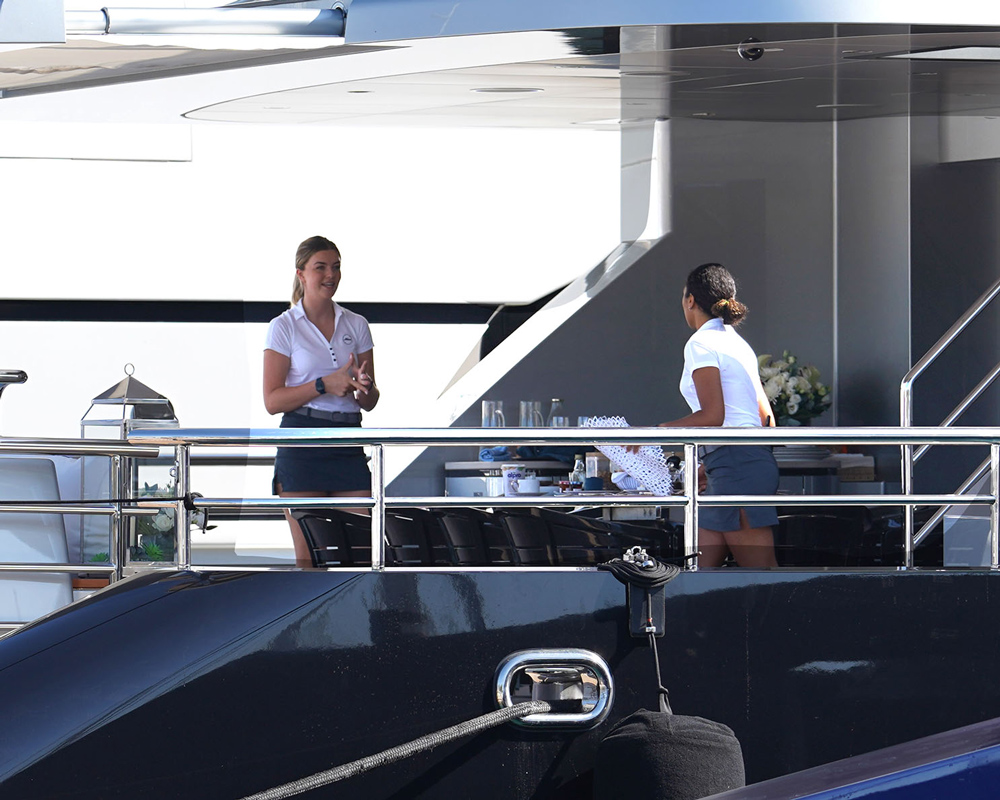
Much of your time will be spent on cabins, keeping guest and owner cabins immaculate. That means precise bedmaking, spotless mirrors and caring for delicate surfaces such as leather and marble. You’ll also spend a lot of time in the laundry, washing and pressing delicate fabrics, removing stains, ironing crew uniforms and keeping the linen stores organised.
When guests are onboard, you’ll help the senior crew with service. You might set tables for breakfast and dinner, make coffee and serve drinks. If you’re dayworking in port, you’ll take on short jobs such as deep cleaning and polishing, which earn you a day rate and, importantly, a reference from a working Captain or Chief Stewardess.
How you’ll feel
At first, you’ll probably feel nervous and unsure of yourself. You’ll worry about getting things wrong or slowing the team down, but almost everyone feels this way in their first few weeks.
You’ll also be tested. Yachting is demanding, with long, physical days, and during a busy charter there will be moments when you’re exhausted, overwhelmed and wondering why you signed up. That’s part of working in high-end hospitality at sea, and every experienced Stew has been through it.
Then there are the other moments. You’ll step out on deck at sunrise and realise you’ve woken up in St Tropez, Monaco or the Bahamas. You’ll see your first full salary arrive, with no rent or bills to pay, and feel a real sense of pride that you’re actually doing it.
Stage 2: Building experience
Role: Senior Stewardess
Yacht size: Typically larger yachts with an interior team of at least three or four Stews
Work type: Mostly permanent positions, some seasonal contracts
Pay: Typically €3,000 to €3,500+ a month, rising to €4,000+ on larger yachts, plus tips on charter yachts
Typical experience: 2 to 4 years
Useful qualifications: WSET wine qualifications, barista training
After a year or two, you’ll no longer feel like the new person.
You’ll know how a busy trip runs, you can anticipate what guests need before they ask, and the Captain and Chief Stewardess have started to trust you. This is usually when you’d decide to move towards a speciality, whether it be: Head of Service, Lead Housekeeper, Laundry Master, Owner’s Concierge, Purser, Wardrobe Manager, on board Florist etc. This is when you’ll begin to tailor your CV and organise further training to develop your skills.
It’s also the stage when most Stews start to work out what kind of yacht suits them. The job of a Senior Stew varies and is dependent on the size of yacht, if you decide to upsize to a larger team, you will usually have to sidestep or move down in rank.
For example, a Chief Stewardess on an 80m would have very similar responsibilities to a 2nd Stewardess on a 100m+ yacht.
What you’ll do day to day
You’ll still spend plenty of time on service, cabins and laundry, but you’ll now have more responsibility for how the day runs. You’ll help the Chief Stewardess plan duties, keep track of guest preferences and make sure standards are met across the interior.
You’ll also start training the junior crew, showing them how things are done onboard and checking their work. When the Chief Stewardess or 2nd Stewardess is off duty, you’ll often step in to run the interior, so you’ll get your first real taste of leading a team.
How you’ll feel
The early nerves will have faded and in their place you’ll feel far more confident in your own ability. There’s real satisfaction in knowing your job well and being the person junior crew come to for help.
Leading people can feel uncomfortable at first, especially if you’re managing a crew you started out alongside. Learning to give instructions clearly and fairly takes practice, and most Senior Stewardesses find this is the part of the role where they grow the most.
Stage 3: Taking responsibility
Roles: Chief Stew or 2nd Stew
Yacht size: Chief Stew on smaller yachts or 2nd Stew on 100m+
Work type: Permanent positions, with rotation available on most larger yachts
Pay: €6,000+ a month depending on yacht size
Typical experience: Often around 3 to 4 years for 2nd Stew, 5+ for Chief Stew
Useful qualifications: Leadership and management training, advanced wine qualifications
On a larger yacht, the natural step is 2nd Stew, where you are on the floor managing the interior team for an admin based Chief Stewardess. The task of organising a team of 10+ Stews requires the head of the department to run schedules and hiring processes, taking them away from the team on a daily basis. The Chief Stewardess will rely heavily on 2nd Stew or sub-department heads such as Head of Service, Head of Housekeeping, Laundry Master, to supervise the smooth running of daily tasks. After time and close training, the 2nd Stew of a larger yacht may step down in yacht size to become a Chief Stew or take over the role on the same vessel if the role becomes available.
On a smaller yacht, where sub department heads aren’t necessary, you might become a Chief Stew instead, running the entire interior on your own. All responsibilities for the interior department and guest requirements will fall on you and you’ll need to delegate tasks and manage the team accordingly.
What you’ll do day to day
As a Chief Stewardess, much of your day is spent managing rather than doing. You’ll plan rotas, manage budgets and inventory, order supplies, and work closely with the Captain and Head Chef to plan each guest trip. You’re the main point of contact for all guests, so you’ll handle their requests personally and make sure every detail of their stay is right. You’ll also be responsible for your team’s training, wellbeing and performance.
How you’ll probably feel
Stepping into either role brings a new kind of pressure. With managing the Interior team, the standard is set by you and it’ll be your duty to ensure the team meets those standards.
With that pressure comes real independence and pride. Many stewardesses say this is when yachting starts to feel like a genuine career, as you’re trusted to run things your way and see the results of your own decisions.
Stage 4: Head of Interior careers
Roles: Purser, Interior Manager and Head of Interior
Yacht size: Most common on larger yachts, particularly 90 metres and above
Work type: Permanent positions, often on rotation
Pay: Varies considerably depending on the role, yacht size and experience. Normally €7,000 minimum.
Typical experience: Usually seven years or more
Useful qualifications: Advanced leadership and management training, accounting or administration experience, languages, Purser certification
This stage isn’t for everyone. You may decide you’re completely content with your level of responsibility at Stage 2 or Stage 3. Managing whole departments and taking on heavy administrative tasks isn’t for everyone, so if you’re reading this thinking you don’t want to become a Purser, remember that you don’t have to, there is plenty of long-term success to be found at every level.
On the largest yachts, there are roles above Chief Stewardess. These positions are fewer in number and tend to go to people with a strong track record, good references and a wide network of industry contacts.
Many of these roles come with rotation, where you work for a set period and then have the same amount of time at home, such as two months on and two months off. For many senior crew, rotation is what makes a long yachting career sustainable, because it lets you build a life ashore alongside your job at sea.
What you’ll do day to day
A Purser often manages the yacht’s administration and accounts as well as the interior, handling crew paperwork, budgets, guest logistics and arrangements ashore.
An Interior Manager or Head of Interior may oversee several departments, such as service, housekeeping and laundry, each with its own head reporting to them.
In both roles, you’ll spend more time planning, communicating and managing people than working hands-on in the interior. You’ll work closely with the Captain, the owner’s representatives and the management company to keep the yacht running smoothly.
How you’ll feel
At this level, the work is less physical but the responsibility is greater. You’ll be managing large teams and budgets, and the owner and Captain will expect everything to run seamlessly.
It’s also a stage where many crew feel settled. Having reached the top of the interior department, and often working on rotation, you have the experience, income and time at home to plan your future on your own terms.
Stage 5: Life after yachting
Common next steps: Luxury hospitality, villa and estate management, private households, events, yacht management, recruitment and training
What you’ll take with you: Years of experience in high-end service, leadership, discretion, working under pressure and communicating with high net worth individuals
Many Stewardesses don’t stay at sea forever, and the skills you build onboard are highly valued ashore. Years of looking after demanding guests, running an interior to exacting standards and keeping calm under pressure make you a strong candidate across many industries.
Former Stews often move into luxury hotels, private villa and estate management, events, or managing households for private families. Others stay close to the industry, working for crew agencies, yacht management companies or charter brokers. Some go into training, sharing what they’ve learned with the next generation of crew, which is exactly what many of our own instructors at Flying Fish have done.
Many crew also leave yachting with savings behind them, having spent years with few living costs. That can give them the freedom to buy a home, start a business or take their time deciding what comes next.
Where will your career take you?
Every career in yachting starts in the same place, with a first job and a willingness to learn.
Where it goes from there is up to you, whether that’s a few memorable seasons, a long career at the top of the interior department or a new path ashore built on everything you’ve learned.
If you’re ready to take the first step, our Yacht Stewardess Course gives you the qualifications, skills and guidance to get there.